

ICIMTech 2025 Insight
The publication record from 2017 to 2025 shows that ICIMTech has moved beyond a narrowly technical forum. Its output is now characterized by a stable annual publication base and a strong intersection between computer science, decision sciences, business, and applied social domains.

A Publication Profile that has Matured
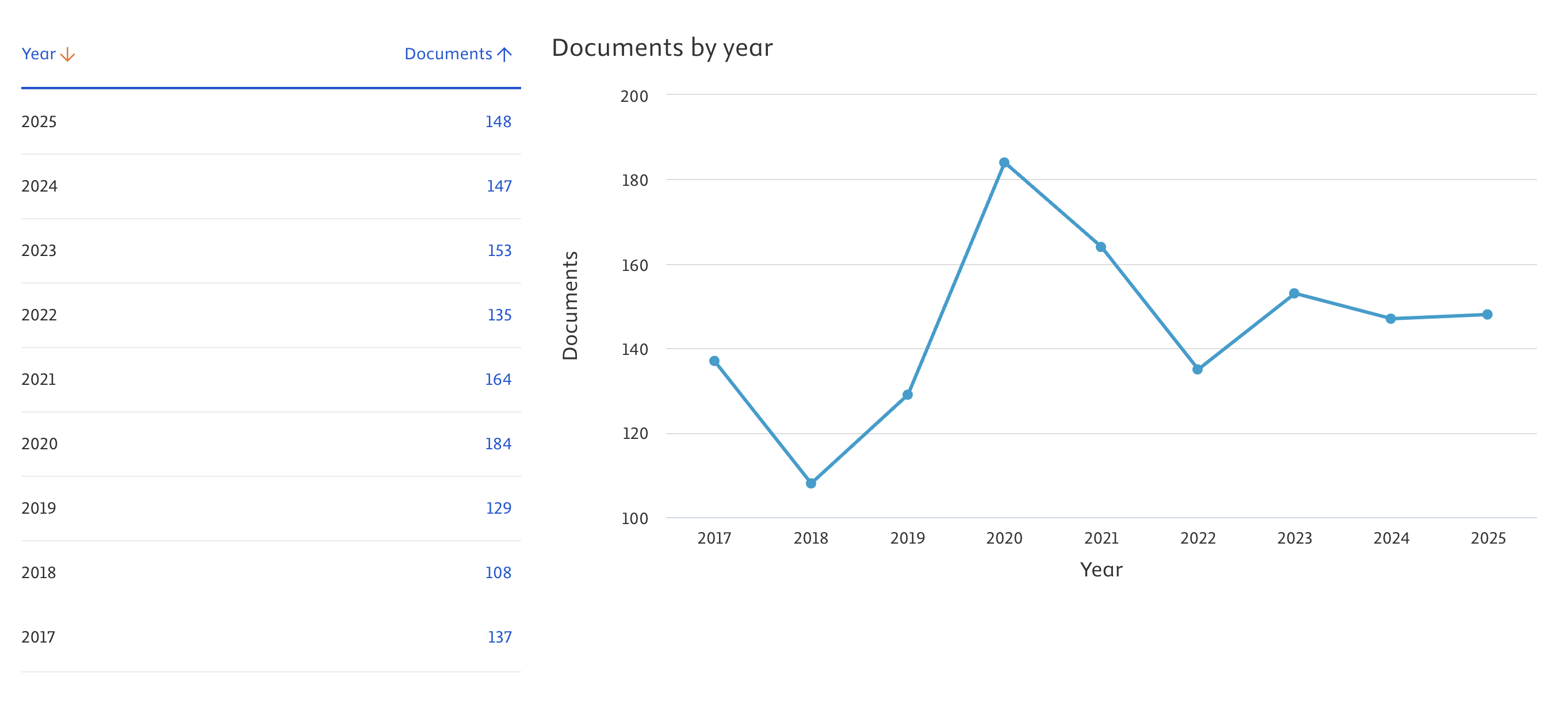
Across the nine publication years shown in the dataset, ICIMTech produced 1,305 documents. The annual pattern is not a straight line, but it reveals a conference that has developed a dependable publication rhythm. Output began at 137 documents in 2017 and fell to the period low of 108 in 2018. It then recovered to 129 in 2019 before reaching a pronounced peak of 184 documents in 2020. Although volume eased to 164 in 2021 and 135 in 2022, the later years show renewed stability: 153 documents in 2023, 147 in 2024, and 148 in 2025.
The trajectory can be read in three phases. The first phase, from 2017 to 2019, was characterized by fluctuation and rebuilding. The second phase, centered on 2020 and 2021, represented the strongest publication expansion in the series. The third phase, from 2022 onward, reflects normalization around a still-substantial level. The decline from the 2020 peak to 2022 was 26.6%, but the following year delivered a 13.3% recovery. Most importantly, the 2025 total is 8.0% above 2017 and 37.0% above the 2018 low. This suggests that the conference has retained more publication capacity than it had in its earlier years, even after the exceptional 2020 high.
Source: scopus.com
A Multidisciplinary Identity Anchored in Computing and Decisions
The subject-area distribution provides an even clearer view of ICIMTech’s academic identity. Computer Science is the largest classification with 1,305 subject assignments, representing 29.1% of the total. Decision Sciences follows closely with 1,157 assignments or 25.8%. Combined, these two fields account for 54.9% of all subject classifications, confirming that the conference’s core lies in digital technology, analytics, information systems, modeling, and evidence-based decision-making.
The third-largest area, Business, Management and Accounting, contributes 880 assignments or 19.6%. This is strategically important because it demonstrates that ICIMTech research frequently connects technology with organizational value, user adoption, financial services, business processes, and management practice. Together, the three leading subject areas make up 74.5% of the distribution. The conference is therefore neither purely computational nor purely managerial; its strongest position is at the boundary where technical innovation is evaluated through decisions, implementation, and business impact.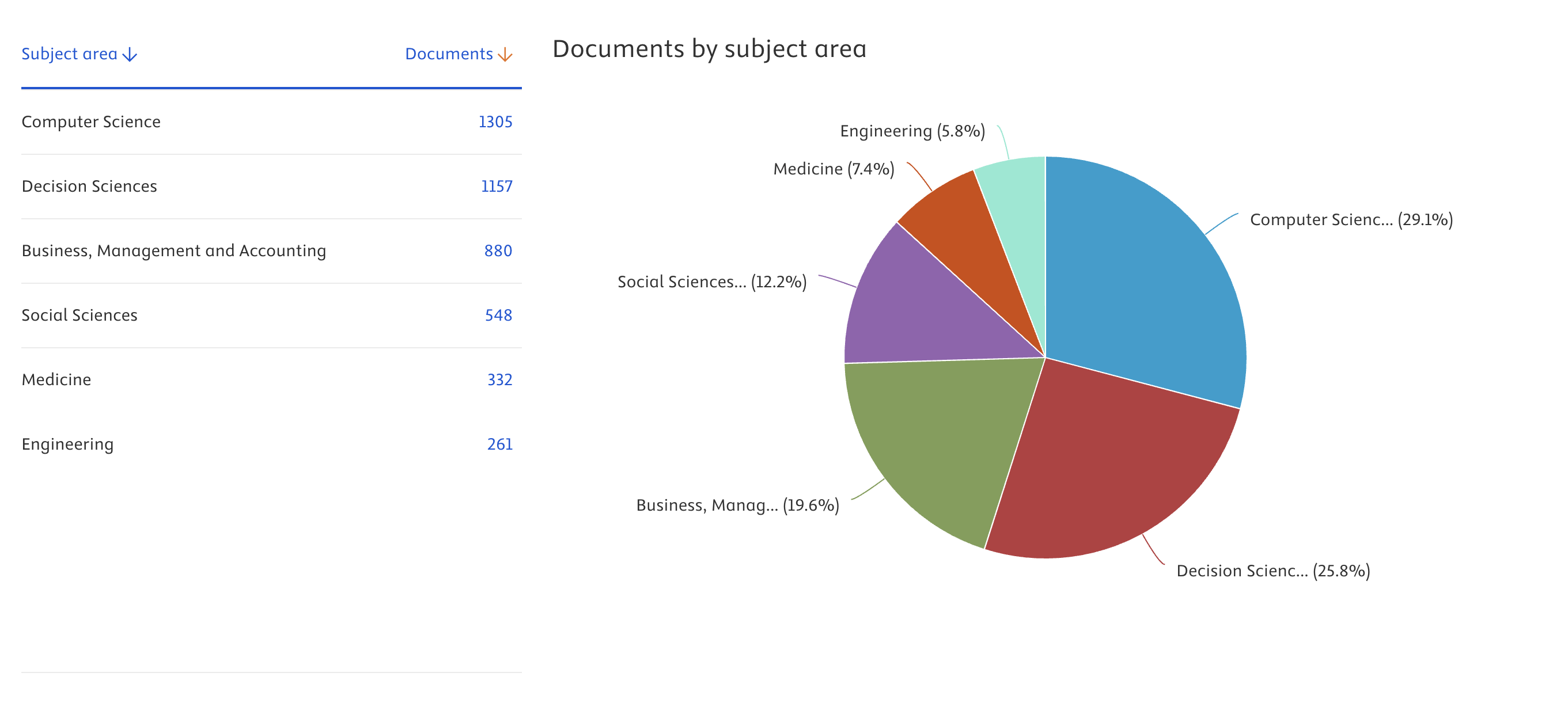
Source: scopus.com
The remaining classifications broaden this profile. Social Sciences represents 548 assignments or 12.2%, indicating sustained attention to people, society, communication, education, behaviour, and technology adoption. Medicine contributes 332 assignments or 7.4%, while Engineering accounts for 261 or 5.8%. Although smaller, these categories are meaningful because they show how ICIMTech methods are being applied to domain problems beyond mainstream information technology. The sum of the subject-area counts is greater than the number of unique documents because Scopus may classify one publication under more than one field; this overlap is itself evidence of interdisciplinary research.
Citation Examples Show Applied Relevance
The supplied Scopus citation extract reinforces this multidisciplinary picture. Its ten selected records average 57.3 citations and cover medical image classification, financial technology, mobile-payment acceptance, customer segmentation, manufacturing defect detection, agricultural computer vision, batik classification, metaverse research, and Indonesian-language hate-speech detection. The most-cited paper in the extract, “A survey of medical image classification techniques,” recorded 117 citations. These examples suggest that ICIMTech gains visibility when researchers combine a clear methodological contribution with a concrete sector, dataset, or social need.
What The 2025 Profile Means for The Next Phase
The 2025 result should be interpreted as a platform for quality-led growth rather than simply a target for higher volume. With annual output now stable at roughly 150 documents, the next opportunity is to deepen research influence. Stronger thematic tracks in artificial intelligence, data analytics, cybersecurity, digital business, responsible technology, and decision support would align naturally with the current subject profile. At the same time, dedicated cross-domain tracks could help expand contributions in medicine, engineering, education, sustainability, and public services without weakening the conference’s information-management core.
Future monitoring should therefore combine publication counts with indicators such as citation performance, international co-authorship, institutional diversity, open-access availability, and the share of papers that connect technological methods to measurable organisational or societal outcomes. The central insight from the data is that ICIMTech already possesses a recognisable and valuable niche: it connects computing with decisions and management, while remaining open to applied research across multiple sectors. The steady 2025 publication level shows continuity; the subject distribution shows breadth; and the citation examples show that well-positioned ICIMTech papers can achieve substantial visibility. The conference’s next phase should build on all three strengths.
*Data note: Annual publication counts and subject-area figures are based on the supplied Scopus analytics. Subject classifications can overlap, so their combined total is higher than the number of unique documents. Citation examples are drawn from the supplied Scopus dated 27 July 2026.